This course is very solid, but rather over the top in some places. In many ways, it seems like some long tees were put in place simply to add length with no thought at all to strategy. The 256 yard 17th and 231 yard 6th come to mind readily. In general, the par 3's are not very good. They come off as repetitive. However, the par 4's and 5's are solid. However, the routing is not the best, especially holes 11, 12 and 13. All that said, despite the flaws, the course is quite good; the second best Trail course I have played after Ross Bridge.
Rating
Variety of Design: The par 3's are very repetitive. The yardage range is fair, going from 187 to 256 yards. However, 3 of those holes play over water, one island, one peninsula jutting out into a lake, and one set back into a hill over a lake. The par 4's have solid variety in yardage, from 358 to 478 yards, with good range in between. And the par 5's are very good with 2 that mandate solid tee shots and have interesting second shots, 1 that is on the outer edges of being reachable in two shots, giving the player the option of doing so, and the final hole is most certainly unreachable by all players at 711 yards. Directionally the course has 5 holes playing to the right, 3 holes playing left and 10 holes playing straight. 6 1/2 out of 10
Flow of the Course: The course flows very well. The course starts off the a big opening, playing far down hill overlooking the Montgomery city skyline. From there, the course moves through some very solid holes, chances to make birdie, and some very difficult holes. It plays up and down quite well before coming to a very good finish, having a very good chance for birdie on #15, an extremely difficult 16th, solid 17th and rather easy 18th that is very scenic. 6 1/2 out of 10
Condition of the Course: The conditions are solid and what one would expect based on price point and expectations. 7 out of 10
Walkability: This course would be a very difficult walk. The huge hill that separates the course from the clubhouse must be walked at the end of the round and many of the holes are quite spread out. It's a slightly easier walk than Ross Bridge would be, but not much easier. 2 3/4 out of 10
Atmosphere: This course is the only RTJ Trail course to have been ranked in the Public Top 100 by Golf Digest, so it may have a little bit of atmosphere and expectation, but overall, there is not much there to amplify the experience. 3 out of 10
Total: 61 3/4 out of 100
Hole by hole analysis and pictures to come soon.


Tuesday
TPC Louisiana- New Orleans, LA
This is a solid course designed by Pete Dye. The course has a really solid set of par 4's with just about as much variety in yardage as a course can have. However, the par 3's and par 5's are a little bit repetitive. The par 3's all fall close to the same yardage and the par 5's are all at the outer edge of being reachable in two shots, at least from the Dye Tees (the club does not allow public players to play from the Tournament tees). The course is not really designed to be played in high winds, though it is doubtful that strong winds affect the course all that often. Overall, this is a solid golf course that may be among the dozen best courses on the Gulf Coast.
Ranking
Variety of Design: As mentioned above, the course has very good variety in the par 4's. The holes go from 336 to 470 yards; there is also the 351 yard 13th hole which is right at the outer limits of being driveable given the set-up of the hole. The par 3's lack a bit ranging from 167 to 195 yards and the par 5's range from 527 to 565 yards. Directionally, the course is fair, having holes distributed: 9 straight, 5 left, 4 right. And the greens are well built for shape and size, testing the desired approach clubs in an appropriate manner. 7 1/4 out of 10
Flow of the Course: The course flows very, very well. The front nine builds through easy and hard holes, heroic, strategic, all types. On the back nine, the course works through nicely, before building to a solid finish on the final 3 holes. The finish has been seen in similar form on many other Dye courses, but as a formula, it works quite well. 7 1/2 out of 10
Course Conditioning: The conditioning was solid. One would suppose that the conditions would be fantastic the week after the Zurich Classic, but overall, the conditions are solid, slightly better than other courses in the area. 7 out of 10
Walkability: The course is built on very flat land and is routed with reasonable green to tee distances. It would not be a great surprise for a player to be able to walk the course all the way around and not become short of breath. But there are a few places with longer walks. 7 out of 10
Atmosphere: The course hosts a PGA Tour event and is a TPC branded course. That likely adds to the atmosphere and value for most golfers. While the course is no Pebble Beach or Augusta National, the atmosphere is the club is quite nice while also being an understated Southern type. 4 1/2 out of 10
Total: 69 3/4 out of 100
Pictures and hole by hole analysis to come shortly.
Ranking
Variety of Design: As mentioned above, the course has very good variety in the par 4's. The holes go from 336 to 470 yards; there is also the 351 yard 13th hole which is right at the outer limits of being driveable given the set-up of the hole. The par 3's lack a bit ranging from 167 to 195 yards and the par 5's range from 527 to 565 yards. Directionally, the course is fair, having holes distributed: 9 straight, 5 left, 4 right. And the greens are well built for shape and size, testing the desired approach clubs in an appropriate manner. 7 1/4 out of 10
Flow of the Course: The course flows very, very well. The front nine builds through easy and hard holes, heroic, strategic, all types. On the back nine, the course works through nicely, before building to a solid finish on the final 3 holes. The finish has been seen in similar form on many other Dye courses, but as a formula, it works quite well. 7 1/2 out of 10
Course Conditioning: The conditioning was solid. One would suppose that the conditions would be fantastic the week after the Zurich Classic, but overall, the conditions are solid, slightly better than other courses in the area. 7 out of 10
Walkability: The course is built on very flat land and is routed with reasonable green to tee distances. It would not be a great surprise for a player to be able to walk the course all the way around and not become short of breath. But there are a few places with longer walks. 7 out of 10
Atmosphere: The course hosts a PGA Tour event and is a TPC branded course. That likely adds to the atmosphere and value for most golfers. While the course is no Pebble Beach or Augusta National, the atmosphere is the club is quite nice while also being an understated Southern type. 4 1/2 out of 10
Total: 69 3/4 out of 100
Pictures and hole by hole analysis to come shortly.
Saturday
Upcoming Posts- January
Since this actually worked last time I did it, I'll give it another shot:
Monday, January 21st: Course Review- TPC Louisiana
Tuesday, January 22nd: Course Review- RTJ @ Capitol Hill (Legislator)
Thursday, January 24th: Opinion
Saturday, January 26th: Course Review- RTJ @ Capitol Hill (Senator)
Monday, January 28th: Course Review- RTJ @ Capitol Hill (Judge)
Tuesday, Janary 29th: Opinion
Thursday, January 31st: Course Review- Bay Breeze
Monday, January 21st: Course Review- TPC Louisiana
Tuesday, January 22nd: Course Review- RTJ @ Capitol Hill (Legislator)
Thursday, January 24th: Opinion
Saturday, January 26th: Course Review- RTJ @ Capitol Hill (Senator)
Monday, January 28th: Course Review- RTJ @ Capitol Hill (Judge)
Tuesday, Janary 29th: Opinion
Thursday, January 31st: Course Review- Bay Breeze
Friday
Where to Build a Golf Course
This article used with permission from my friend Melvyn Morrow. It ties in very with some of the things I have written here and the way the game of golf should go.
Good sites for golf courses - what the definition of a good site? There may be many that appear to be good sites but that IMHO is the wrong approach when selecting a location for a new golf course. The question is not is it a good site but is the land fit for purpose.
Many may wonder just what is the difference. There is a very big difference and that is in the land itself. Land fit for purpose should result in much that was seen and visible on initial inspection/survey coming into play with minor modification while good sites are ready to strip, reform, shape and mould the land to the wishes of the club/owner/designers will.
To my mind Golf Courses should reflect the game, with the original land, its surroundings sitting comfortably while being easily sustainable within the local environment. Yet we have moved so far from producing the Scottish Course Designs that made golf a worldwide sport in the first place. We for some mad reason seem to believe today, well for the last 50-60 years that it is acceptable to rape the land. To destroy the very land that initially presented itself as potentially a good site. Nevertheless land can very quickly be defined as not ‘Fit for Purpose’ proven by the high cost of land clearance, reshaping and then reforming as a golf course. Is this the product of nearly 200 years of golf course architecture; of accumulative wisdom by the designers/architects that all land required for golf must be rebuild, reshape and form to suit the wishes of a club no matter the cost or harm to the whole local environment i.e. from drainage, water tables introducing new grasses etc., etc. Not to mention the on-going financial burden placed upon the club for both the build and annual maintenance packages.
Golf courses are not just pieces of land but a key part of the game. They are meant to throw out the initial challenge to the golfer. By that I mean the course should represent the challenge both from the land with its natural penal nature with the additional cunningness and flare from the designer employing his additional use of the land to make manmade and enhance natural hazards to test the golfer. Courses are not country parks. They should not suffer from the modern total strip back to reforming as seems to be the current building methods, and most certainly not suffer long walks between Green & Tees. This does not equate with golf, its traditions or quite frankly the smooth continuity of the game. Nor does it reflect the true meaning of golf which in part must be measured by the natural harmony of walking over Natures contours while facing obstacles and challenges that ultimately promotes the skill of the golfer.
Good sites do not equate into sites Fit for Purpose – and anyway in these austere times should we not be endeavouring to tightly control budgets for both ‘Build & Maintenance’ packages.
Because we have the finances and technology is no excuse to building a golf course in an area not suitable for the Royal & Ancient Game of Golf.
For clarification, based on my since edited comment, the Royal & Ancient Game as Melvyn describes it should not be thought to mean seaside links only. He simply means that courses should be built on reasonable sites that do not require massive amounts of earth moving to build and millions of gallons of water to maintain. This is not something I disagree with.
Good sites for golf courses - what the definition of a good site? There may be many that appear to be good sites but that IMHO is the wrong approach when selecting a location for a new golf course. The question is not is it a good site but is the land fit for purpose.
Many may wonder just what is the difference. There is a very big difference and that is in the land itself. Land fit for purpose should result in much that was seen and visible on initial inspection/survey coming into play with minor modification while good sites are ready to strip, reform, shape and mould the land to the wishes of the club/owner/designers will.
To my mind Golf Courses should reflect the game, with the original land, its surroundings sitting comfortably while being easily sustainable within the local environment. Yet we have moved so far from producing the Scottish Course Designs that made golf a worldwide sport in the first place. We for some mad reason seem to believe today, well for the last 50-60 years that it is acceptable to rape the land. To destroy the very land that initially presented itself as potentially a good site. Nevertheless land can very quickly be defined as not ‘Fit for Purpose’ proven by the high cost of land clearance, reshaping and then reforming as a golf course. Is this the product of nearly 200 years of golf course architecture; of accumulative wisdom by the designers/architects that all land required for golf must be rebuild, reshape and form to suit the wishes of a club no matter the cost or harm to the whole local environment i.e. from drainage, water tables introducing new grasses etc., etc. Not to mention the on-going financial burden placed upon the club for both the build and annual maintenance packages.
Golf courses are not just pieces of land but a key part of the game. They are meant to throw out the initial challenge to the golfer. By that I mean the course should represent the challenge both from the land with its natural penal nature with the additional cunningness and flare from the designer employing his additional use of the land to make manmade and enhance natural hazards to test the golfer. Courses are not country parks. They should not suffer from the modern total strip back to reforming as seems to be the current building methods, and most certainly not suffer long walks between Green & Tees. This does not equate with golf, its traditions or quite frankly the smooth continuity of the game. Nor does it reflect the true meaning of golf which in part must be measured by the natural harmony of walking over Natures contours while facing obstacles and challenges that ultimately promotes the skill of the golfer.
Good sites do not equate into sites Fit for Purpose – and anyway in these austere times should we not be endeavouring to tightly control budgets for both ‘Build & Maintenance’ packages.
Because we have the finances and technology is no excuse to building a golf course in an area not suitable for the Royal & Ancient Game of Golf.
For clarification, based on my since edited comment, the Royal & Ancient Game as Melvyn describes it should not be thought to mean seaside links only. He simply means that courses should be built on reasonable sites that do not require massive amounts of earth moving to build and millions of gallons of water to maintain. This is not something I disagree with.
Wednesday
RTJ @ Capitol Hill
Tomorrow I will, hopefully, be playing all 54 holes at Capitol Hill in Prattville, Alabama. The Judge course is supposed to be very good and also very long. I have top expectations for that one. The Senator course is host of the LPGA Navistar Classic, and it supposed to be built like a links course, so I have reason to believe it should be good as well. The Legislator course I don't know much about, so expectations will be modest. Hopefully it will be great fun all day and I will be able to get in all 54 holes. Reports to come on each course.
Tuesday
Why do we keep playing?
What keeps us coming back to the course day after day, week after week, playing this game that drives us mad? For me, I like to keep coming back because of the constant challenge the game provides and the thrill of playing new golf courses. These things bring me back to the game time after time.
I've never played a round where I felt like I'd hit every shot solid and played the absolute best I could play. I've played rounds where I shot, 3, 4, 5 shots under par. But those rounds were never perfect. I always missed a short putt or hit a really loose drive, something. Having been a competitor in the past and played top quality golf, it is those missed shots, just as much as the great ones, that keep me coming back to the course. It's a never ending quest for perfection, but one that continues to be enjoyable.
But it's also always fun to play new courses. And that quest to play new courses...well, I guess it's not exactly a quest, it's more that I just play them because they are there. I have on the site here that I want to play the Public Top 100, but I don't make tremendous effort to play those. I'll just play them as the opportunity provides itself, but don't really intend to take long trips to the middle of Nebraska, without something else involved, in order to play them. But even the most average of courses still provide fun and enjoyment when playing them for the first time. It's simply fun taking the journey into the unknown on a new course.
Some people might have other reasons for playing golf. Competition, exercise (which is another reason, though a much lesser one, that I play), or who knows what else. But either way, people love to play the game of golf. I'm certainly one of those and I intend to continue enjoying this game for as long as I can.
I've never played a round where I felt like I'd hit every shot solid and played the absolute best I could play. I've played rounds where I shot, 3, 4, 5 shots under par. But those rounds were never perfect. I always missed a short putt or hit a really loose drive, something. Having been a competitor in the past and played top quality golf, it is those missed shots, just as much as the great ones, that keep me coming back to the course. It's a never ending quest for perfection, but one that continues to be enjoyable.
But it's also always fun to play new courses. And that quest to play new courses...well, I guess it's not exactly a quest, it's more that I just play them because they are there. I have on the site here that I want to play the Public Top 100, but I don't make tremendous effort to play those. I'll just play them as the opportunity provides itself, but don't really intend to take long trips to the middle of Nebraska, without something else involved, in order to play them. But even the most average of courses still provide fun and enjoyment when playing them for the first time. It's simply fun taking the journey into the unknown on a new course.
Some people might have other reasons for playing golf. Competition, exercise (which is another reason, though a much lesser one, that I play), or who knows what else. But either way, people love to play the game of golf. I'm certainly one of those and I intend to continue enjoying this game for as long as I can.
Sunday
Year In Review
2012 was a good year for me.
Highlights
-Playing Peachtree in October. This is certainly the best course I have played since Pebble Beach and the best course I have played in the Southern US.
-The Hundred Hole Hike in July. This was both fun and painful. Walking 100 holes in a day was very difficult. But the reward that came from raising over $2000 for charity was great.
-Playing Oxmoor Valley and Ross Bridge in June. This was a lot of fun and the first time I'd played 4 different golf courses in a single day. I don't expect to top that any time soon, if ever.
-Played a total of 30 new golf courses and 6 of those ended up in my personal Top 25.
-TPC Louisiana in December. This course exceeded expectations. I didn't expect the course to have so much variety and interest.
-Ross Bridge in June. Greatly exceeded expectations. For the course to be so long it has great interest and is quite fun to play.
-Met some great guys both through internet groups and random pairings on the course.
Upcoming Plans
-Currently planning to play at least 9 courses in January. 8 different courses on the RTJ Trail and East Lake.
-Hopefully I can take advantage of the Trail offer of $21 on the 21st this year like I did this past year. After January, I'll have 3 Trail sites to play (Hampton Cove, The Shoals, and Highland Oaks) plus 1 course at both Cambrian Ridge and Lakewood. Hopefully I can finish all those this year.
-And hopefully I can meet some new friends on and off the course while playing some new rounds.
Thanks to all my readers here, I hope to grow this site over the next year to greater size than it is right now. The growth over the last half year has been great. I greatly appreciate all of you that read here. Any suggestions for content will be considered. Thank you and here's to next year.
Highlights
-Playing Peachtree in October. This is certainly the best course I have played since Pebble Beach and the best course I have played in the Southern US.
-The Hundred Hole Hike in July. This was both fun and painful. Walking 100 holes in a day was very difficult. But the reward that came from raising over $2000 for charity was great.
-Playing Oxmoor Valley and Ross Bridge in June. This was a lot of fun and the first time I'd played 4 different golf courses in a single day. I don't expect to top that any time soon, if ever.
-Played a total of 30 new golf courses and 6 of those ended up in my personal Top 25.
-TPC Louisiana in December. This course exceeded expectations. I didn't expect the course to have so much variety and interest.
-Ross Bridge in June. Greatly exceeded expectations. For the course to be so long it has great interest and is quite fun to play.
-Met some great guys both through internet groups and random pairings on the course.
Upcoming Plans
-Currently planning to play at least 9 courses in January. 8 different courses on the RTJ Trail and East Lake.
-Hopefully I can take advantage of the Trail offer of $21 on the 21st this year like I did this past year. After January, I'll have 3 Trail sites to play (Hampton Cove, The Shoals, and Highland Oaks) plus 1 course at both Cambrian Ridge and Lakewood. Hopefully I can finish all those this year.
-And hopefully I can meet some new friends on and off the course while playing some new rounds.
Thanks to all my readers here, I hope to grow this site over the next year to greater size than it is right now. The growth over the last half year has been great. I greatly appreciate all of you that read here. Any suggestions for content will be considered. Thank you and here's to next year.
Thursday
Designing for Weather and Location
It seems like such an obvious statement. Golf courses should be designed for the meteorological and geographical conditions of the given area. But digging deeper, what does that mean? I look back on a fine course I played about a month ago, The Dunes Golf & Beach Club in Myrtle Beach. The weather when I played was fairly rough, 55 degree temps, winds 20-25 miles per hour out of the north and rather slow fairways due to rain the day before. Catch is, this course was not really designed for conditions like that, at least not from a specific set of tees designed to cater to a specific type of player.
A set of holes that come to mind readily is the stretch from holes 10-13. The 10th hole is a 380 yard par 4, 11 is a 430 yard par 4, 12 is a 245 yard par 3, and 13 is a 590 yard par 5. These holes provide a substantial challenge to the player even in standard conditions when temps are in the mid-80's, the fairways are much more firm and the wind is gentle to moderate out of the south. However, on the day I played, given the conditions above, they were incredibly difficult. Typically, given driver off the tee, I would have approached 10 with a lob wedge, 11 with a pitching wedge, 12 with a 5 wood, and 13 with a sand wedge after a 3 wood second shot. However, given the conditions, I approached with 6 iron, 3 wood, 3 wood (from 185 yards, not 245) and 6 iron after a 3 wood 2nd. So the effective lengths of these holes, based on how I play, were 480 yards, 550 yards, 260 yards (from the 185 tees, I played those because I had just hit a 205 yard drive on 11 that was very well struck and was rather certain I would be unable to clear the water even if I hit a perfect driver) and 730 yards. So because the holes were not really designed to be played from the back tees in conditions like I faced, the effective length of the holes was astronomical.
But the conditions I faced there are not standard there. In fact, there are likely very fews days in the course of an entire year that fit those conditions.
I had a similar thought the first time I played a golf course in Alaska. The Creek course at Moose Run was the first course I played in the state, back in 2009. I played it from the back tees, around 7400 yards. But I played on a day when the temperature was in the mid-70's, a very warm day up there. I couldn't figure out why Golf Digest had ranked this course among the 50 most difficult courses in America. However, when I returned to Alaska in 2012, I played more courses and playing them in "standard" Alaska conditions opened my eyes a bit to why that course might be so difficult. The first two rounds I played were played when the temperatures did not get out of the 50's. On a day like that, which is not uncommon in Alaska even in the peak "heat" of summertime, 7400 yards becomes a incredible length for even the longest of golfers.
Altitude is also something that must be considered when designing for conditions. Edgewood Tahoe plays 7,555 yards from the back tees, but the course sits at 6,200 feet elevation. So it plays effectively much, much shorter than that. I recall hitting driver off the tee on #2 and having less than 50 yards left to the green; #2 is 417 yards from the back tees. On #18 I hit driver off the tee then had yardage that dictated a 6 iron (I had to lay up due to a strong wind coming off the lake to the right and a pond to the left of the green) and #18 is 572 yards long. So obviously with numbers like that, the 7,500 yards becomes more manageable.
But the standard conditions for an area must be used to determine overall course length and individual hole length. This was a concept that I failed to understand for quite some time. While I do still believe that courses of astronomical length are needed to challenge professional golfers and elite amateurs, courses designed for member play, even high level member play, can be designed with a reasonable effective length in mind. Perhaps that number is 6900 yards, perhaps more, perhaps less. Either way, all the conditions must be taken into consideration, by the owners/developers more than the designers (the designer all ready knows the "right" yardage), when determining what length the course will play. After all, 7,195 yards at The Dunes, played at effectively sea level, with temps of 55 degrees and a strong wind is quite a bit longer than 7,555 yards at Edgewood Tahoe, at 6,200 feet above sea level on a 75 degree day with no wind, though the raw numbers indicate the opposite.
A set of holes that come to mind readily is the stretch from holes 10-13. The 10th hole is a 380 yard par 4, 11 is a 430 yard par 4, 12 is a 245 yard par 3, and 13 is a 590 yard par 5. These holes provide a substantial challenge to the player even in standard conditions when temps are in the mid-80's, the fairways are much more firm and the wind is gentle to moderate out of the south. However, on the day I played, given the conditions above, they were incredibly difficult. Typically, given driver off the tee, I would have approached 10 with a lob wedge, 11 with a pitching wedge, 12 with a 5 wood, and 13 with a sand wedge after a 3 wood second shot. However, given the conditions, I approached with 6 iron, 3 wood, 3 wood (from 185 yards, not 245) and 6 iron after a 3 wood 2nd. So the effective lengths of these holes, based on how I play, were 480 yards, 550 yards, 260 yards (from the 185 tees, I played those because I had just hit a 205 yard drive on 11 that was very well struck and was rather certain I would be unable to clear the water even if I hit a perfect driver) and 730 yards. So because the holes were not really designed to be played from the back tees in conditions like I faced, the effective length of the holes was astronomical.
But the conditions I faced there are not standard there. In fact, there are likely very fews days in the course of an entire year that fit those conditions.
I had a similar thought the first time I played a golf course in Alaska. The Creek course at Moose Run was the first course I played in the state, back in 2009. I played it from the back tees, around 7400 yards. But I played on a day when the temperature was in the mid-70's, a very warm day up there. I couldn't figure out why Golf Digest had ranked this course among the 50 most difficult courses in America. However, when I returned to Alaska in 2012, I played more courses and playing them in "standard" Alaska conditions opened my eyes a bit to why that course might be so difficult. The first two rounds I played were played when the temperatures did not get out of the 50's. On a day like that, which is not uncommon in Alaska even in the peak "heat" of summertime, 7400 yards becomes a incredible length for even the longest of golfers.
Altitude is also something that must be considered when designing for conditions. Edgewood Tahoe plays 7,555 yards from the back tees, but the course sits at 6,200 feet elevation. So it plays effectively much, much shorter than that. I recall hitting driver off the tee on #2 and having less than 50 yards left to the green; #2 is 417 yards from the back tees. On #18 I hit driver off the tee then had yardage that dictated a 6 iron (I had to lay up due to a strong wind coming off the lake to the right and a pond to the left of the green) and #18 is 572 yards long. So obviously with numbers like that, the 7,500 yards becomes more manageable.
But the standard conditions for an area must be used to determine overall course length and individual hole length. This was a concept that I failed to understand for quite some time. While I do still believe that courses of astronomical length are needed to challenge professional golfers and elite amateurs, courses designed for member play, even high level member play, can be designed with a reasonable effective length in mind. Perhaps that number is 6900 yards, perhaps more, perhaps less. Either way, all the conditions must be taken into consideration, by the owners/developers more than the designers (the designer all ready knows the "right" yardage), when determining what length the course will play. After all, 7,195 yards at The Dunes, played at effectively sea level, with temps of 55 degrees and a strong wind is quite a bit longer than 7,555 yards at Edgewood Tahoe, at 6,200 feet above sea level on a 75 degree day with no wind, though the raw numbers indicate the opposite.
Wednesday
Stonehouse Golf Club-Toano, VA
Another of the few golf courses that Mike Strantz designed. This one, sadly, lacks that "it" that the other courses have. That said, this is a quality golf course and certainly one to play. This course is simply a normal golf course, if there is such a thing. It does not reach the extremism seen at Tobacco Road and Tot Hill Farm. It does not play extremely difficult like Royal New Kent. This course plays somewhat similar to many other housing based membership clubs. In most cases this would be a fine course, but compared to Mike Strantz's other work, it falls a bit short.
Ranking
Variety of Design: The par 3's have only modest variety, ranging only from 172 to 204 yards. The par 4's virtually all fall in the mid-400 yard range, none being very short nor very long. And the par 5's have only moderate variety as well. Directionally, the holes would seem to balance out well, having 6 holes playing right, 7 holes playing left and 6 playing straight (the 7th doglegs both left and right), yet upon digging a bit deeper one finds that the holes on the front nine are broken down as 6 holes right, 1 left, and 3 straight, while the back nine is 6 left and 3 straight. The overall balance is fair, the by each nine, quite skewed. 5 3/4 out of 10
Flow of the Course: This course has limited flow. None of the holes stand out as exceptional to give high points to the round. But none are so poor as to give extremely low points. 5 out of 10
Course Conditioning: In most places the turf is solid. A few greens had some dead spots due to heat and lack of air flow, but in general, the conditions were what one would expect give the fees. 5 3/4 out of 10
Ease of Walking: Not good. Significant distances between many of the holes, road crossings and hilly terrain makes this a difficult walk. 3 1/4 out of 10
Atmosphere: Mike Strantz being the designer gives a bit of a boost, but other than that, not much atmosphere here. 3 out of 10
Total: 50 out of 100
*All photos property of and used with permission from The Buffalo Golfer www.buffalogolfer.com*
Holes to Note
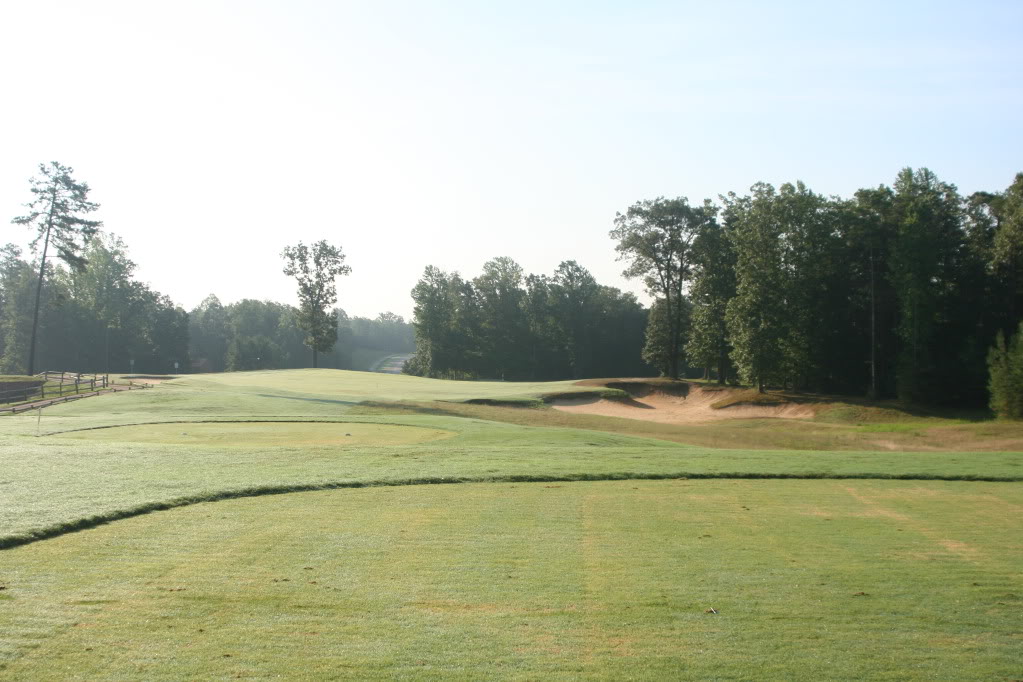
Hole #1: Par 4, 401 yards
This is likely the easiest opening hole from Strantz that I have played. The play off the tee is fairly simple. The bunker on the right can be easily carried, but the player must be mindful of the fact that the fairway ends at 285 yards from the back tee. Longer players may be able to run the ball through the fairway. But in general, the tee shot should not be overly difficult given that the fairway is over 60 yards wide. From the fairway, the player will have an open approach shot to a green cut into the side of a large hill.


Ranking
Variety of Design: The par 3's have only modest variety, ranging only from 172 to 204 yards. The par 4's virtually all fall in the mid-400 yard range, none being very short nor very long. And the par 5's have only moderate variety as well. Directionally, the holes would seem to balance out well, having 6 holes playing right, 7 holes playing left and 6 playing straight (the 7th doglegs both left and right), yet upon digging a bit deeper one finds that the holes on the front nine are broken down as 6 holes right, 1 left, and 3 straight, while the back nine is 6 left and 3 straight. The overall balance is fair, the by each nine, quite skewed. 5 3/4 out of 10
Flow of the Course: This course has limited flow. None of the holes stand out as exceptional to give high points to the round. But none are so poor as to give extremely low points. 5 out of 10
Course Conditioning: In most places the turf is solid. A few greens had some dead spots due to heat and lack of air flow, but in general, the conditions were what one would expect give the fees. 5 3/4 out of 10
Ease of Walking: Not good. Significant distances between many of the holes, road crossings and hilly terrain makes this a difficult walk. 3 1/4 out of 10
Atmosphere: Mike Strantz being the designer gives a bit of a boost, but other than that, not much atmosphere here. 3 out of 10
Total: 50 out of 100
*All photos property of and used with permission from The Buffalo Golfer www.buffalogolfer.com*
Holes to Note
Hole #1: Par 4, 401 yards
This is likely the easiest opening hole from Strantz that I have played. The play off the tee is fairly simple. The bunker on the right can be easily carried, but the player must be mindful of the fact that the fairway ends at 285 yards from the back tee. Longer players may be able to run the ball through the fairway. But in general, the tee shot should not be overly difficult given that the fairway is over 60 yards wide. From the fairway, the player will have an open approach shot to a green cut into the side of a large hill.
The fairway runs from the center of the bunker on the right to a line pointed towards the lone tree on the left. Anything in the fairway will give the player a solid look at the green.

The green is cut deeply into the side of the hill. Shots missed more than a fraction in any direction will be done no favors.
Hole #5: 431 yards
This hole plays fairly long with a blind tee shot and then an approach shot to a Punchbowl green. The best line off the tee is to favor the right side, even with a line over the shorter tree. The green is fairly open in front and could allow for a run-up shot, though that would not be the preferred option.

From the tee, the player is unable to see the fairway. The stake visible in the middle of the fairway is not the 150 yard stake, indeed that stake is more than 225 yards from the green. Any shot left of that stake will not find the fairway.

The green is surrounded on 3 sides by the bowl. Shots hit a slight distance up on the hills will kick down onto the green. The wide opening in front may allow for a roll-up shot, but there is a depression short of the green which likely prevents that.
Hole #14: Par 4, 402 yards
This is a solid hole even though is has an awkward green site. The bunkers visible off the tee are completely out of play unless the player tops a shot. The tee shot is blind and the best line is directly over the two bunkers seen on the left side of the image; the orange bunkers in the foreground to be specific. That will leave the player with 150 or less yards into the green. To a certain degree, the farther right the players tee shot is played, the better, due to angle and being able to see the pin or the green, but this is certainly not a green that one will want to approach with a long iron.

From the tee, the best line is directly over the grass that separates the two orange sand bunkers in the foreground. That will allow the player a clear view of the green.

From around 150 out, this is the look at the green. This is certainly an aerial only approach and any miss hit shot will be severely penalized.

A closer look at the green shows the jungle surrounding the green on all sides.
Hole #18: Par 4, 453 yards
This is a difficult closing hole. The fairway is over 100 yards wide before part of it comes to an end 265 yards off the tee. The shortest line to the green comes from playing the tee shot close down the treeline on the left. This is where the fairway runs out. Playing over to the left, over the large shrubby tree in the center of the below image will give the player more length for the tee shot, but will also leave a longer approach. To the green the player has multiple options. From the shorter route, the player must fly the ball all the way to the green. From the longer route to the right, the player is able to bring the ball in low with a run-up shot. Very solid finishing hole.

The shortest line to the green comes from playing close to the treeline on the left. Players who hit the ball more than 275 yards off the tee will need to play less than driver when playing down this side. From there, the player will have around 170 yards to the center of the green, but the ball must be carried onto the putting surface, there is no run-up option. Players who choose to play to the right, over the shrub, will be left with about 190 yards to the center of the green even if they are able to hit the tee shot 300 yards. This shot, however, can be played with a run-up shot if desired.

From the center of the fairway, both approach options are visible. Anything left of here will not have the option of playing the shot on the ground. Anything right will need more club to reach the green but is able to be played to the green by rolling the ball up. The bunkers serve as saving features for players who slightly miss their approach shots.
Overall, this course is good but not great. It does provide a great break from the ordinary however, and is worth a look because of that. 5 out of 10
Monday
Modern Day Template Holes: The Island
The Island green hole is one of the most used modern 'Template' holes. These holes are not all identical, or very close, like the Macdonald School holes, but the concept is certainly the same for each hole. The nature of the green, being surrounded by water, makes the hole somewhat uniquely capable of bringing drama and a high point to the round.

While not the first Island green built, that distinction is generally thought to belong to Ponte Vedra Country Club just a short ways away, the 17th hole at TPC Sawgrass (PLAYERS Stadium) is the hole that started the trend of island greens. The positioning in the round and the length of the hole, combined with the water-surrounded green, give players in match or stroke play opportunity for any score from 1, which we have seen during the PLAYERS Championship numerous times, to the 66 that Angelo Spagnolo made during the Golf Digest Worst Avid Golfer contest. That is the kind of drama and build-up that other courses have attempted when building the Island hole.

The 17th hole at PGA West (Stadium). This one was designed by Pete Dye a few years after the one at Sawgrass. In the same way, it provides the unique drama to the round, but this hole is over 20 yards longer than the hole at Sawgrass, making it much more difficult.

This is the 16th at Golden Horseshoe (Gold) in Williamsburg, Virginia. This is a much older Island hole, dating to 1964. Obviously the concept is the same, but this hole has more room for the player to miss the green, being surrounded by 5 bunkers and significant rough space.

This one, from Stone Harbor in New Jersey, is one of the holes that went beyond a normal Island concept and into foolishness. This green has since been rebuilt, likely at significant cost, into something more normal. This hole, and the one below, represent what the Island has become to many places, a gimmick to draw attention to the course.

The 14th hole at Coeur d'Alene Resort in Idaho is a true island green, requiring the player to take a boat ride in order to reach the green. The green is located on a barge and the yardage can be changed day to day by allowing the green to float out farther from land. Again, a bit of a gimmick to draw attention.
The Island template is a solid hole. There are those out there who believe that holes with forced water carries are generally unfair. Perhaps they are. After all, there are virtually no options for the player when playing an Island hole. However, there do not always need to be numerous options for the play of a hole. The problem with the Island template or concept of that it has become somewhat overused and that has tarnished the quality of drama and flow to a round this type of hole can provide. But when executed well, this hole provides a high point to a round not matched by many other holes or especially hole types.
Subscribe to:
Posts (Atom)