Saturday

Lakewood Golf Club (Azalea)-Point Clear, AL


The courses at Lakewood Golf Club are the only courses in the Robert Trent Jones Golf Trail family of courses not designed by Mr. Jones and Roger Rulewich. The original course, consisting of holes 1-5 and 15-18 of the Azalea course and holes 10-18 on the Dogwood course, was built in 1947 and designed by Perry Maxwell, one of the great designers of the Golden Age. The other holes have been added on over the years by various designers. It is startling how inferior those additional holes are, on the Azalea course anyway.

However, sadly, based on the rates charged, this course is viewed by many as one of the best courses on the Trail. It simply is not. Based on the eight other Trail courses this writer has seen, Lakewood is no better than any of the original courses and certainly inferior, and significantly, to Ross Bridge. This course simply has no flow. The first five holes flow nicely and six is not a bad par 5, but from there the course weaves through houses that are built tighter than desired to the playing corridors. Hole nine is a sharp dogleg left that plays directly across a public road and under powerlines.

In addition, hole fourteen is one of the worst par 5's this writer has played. While the hole is scenic and photographs well, it is a par 5 played to an island green. Coupled with the fact that it typically plays into the wind and is 545 yards long, there is virtually no risk/reward potential on the hole. Under only the rarest of circumstances would a golfer ever attempt to play to this green in two shots, thus the hole basically becomes a par 3 with two additional shots. The angle of play from the tee does not matter, the ball must merely find the fairway. On the second shot, certainly a lay-up, again, the angle does not matter. No angle into the green changes the situation that the player it hitting to an island. Any shot not played with reasonable precision will find the water, regardless of the approach angle. Simply a poor hole.

This course could have been so much better. Based on the nine original holes, it should be much better. Mr. Maxwell must vomit in his mouth slightly, as he sits watching in the hereafter, every time this course attempts to advertise their Frankenstein course using his good name.

Holes to Note
Hole #2: Par 4, 411 yards
This is quite a nice mid-length par 4. The player is given several options off the tee. The first is to lay back short of the fairway bunker that is around 250 yards off the tee, leaving a shot of over 160 yards to the green. The second option is to play the shot into the fairway even with the bunker, leaving a shorter shot, but having to thread the tee shot into a rather narrow ribbon of fairway. The final option is to play over the bunker, a shot requiring a carry of around 275 yards, into a generous piece of fairway leaving a short wedge into the green. From the fairway, the player will be faced with a shot over a large fronting bunker into a green that falls off away from him. This is no easy hole and certainly fits with much of the work Mr. Maxwell did elsewhere.

From the tee, the options are clearly placed in front of the player. The area right of the bunker is not maintained as fairway and any ball hit there will be stopped and blocked out by the trees.
For the player who tempts fate and plays over the bunker, this open shot is left. Note the opening to the green that would allow the player to play a low running shot into the green, if desired.


Hole #4: Par 3, 203 yards
This is an interesting par 3 that plays over water to one of two separate greens. To the left green, the hole can play up to the 203 yards listed on the card. To the right, it is much shorter, around 170. But both greens are quite small, making a 200 yard shot into the green no bargain.
Sadly, the phone tower takes away from an otherwise picturesque hole.

Hole #17: Par 4, 475 yards
This brute of a par 4 plays roughly straight off the tee, with the prefered play depending on what the player desires for the approach shot. The fairway is not reachable from the back tee, unless the player can hit a ball 325 yards or better. A play away from the bunker will give the player the better angle into the long, but narrow, green. A play directly towards the bunker will leave the player less margin for error in distance control. The key feature of the green, however, is the significant fall off that runs down the entire right side of the green. If a player feels good about distance control, but not direction, the right side of the fairway would be a bit better. The player who has poor distance control should favor the left side.
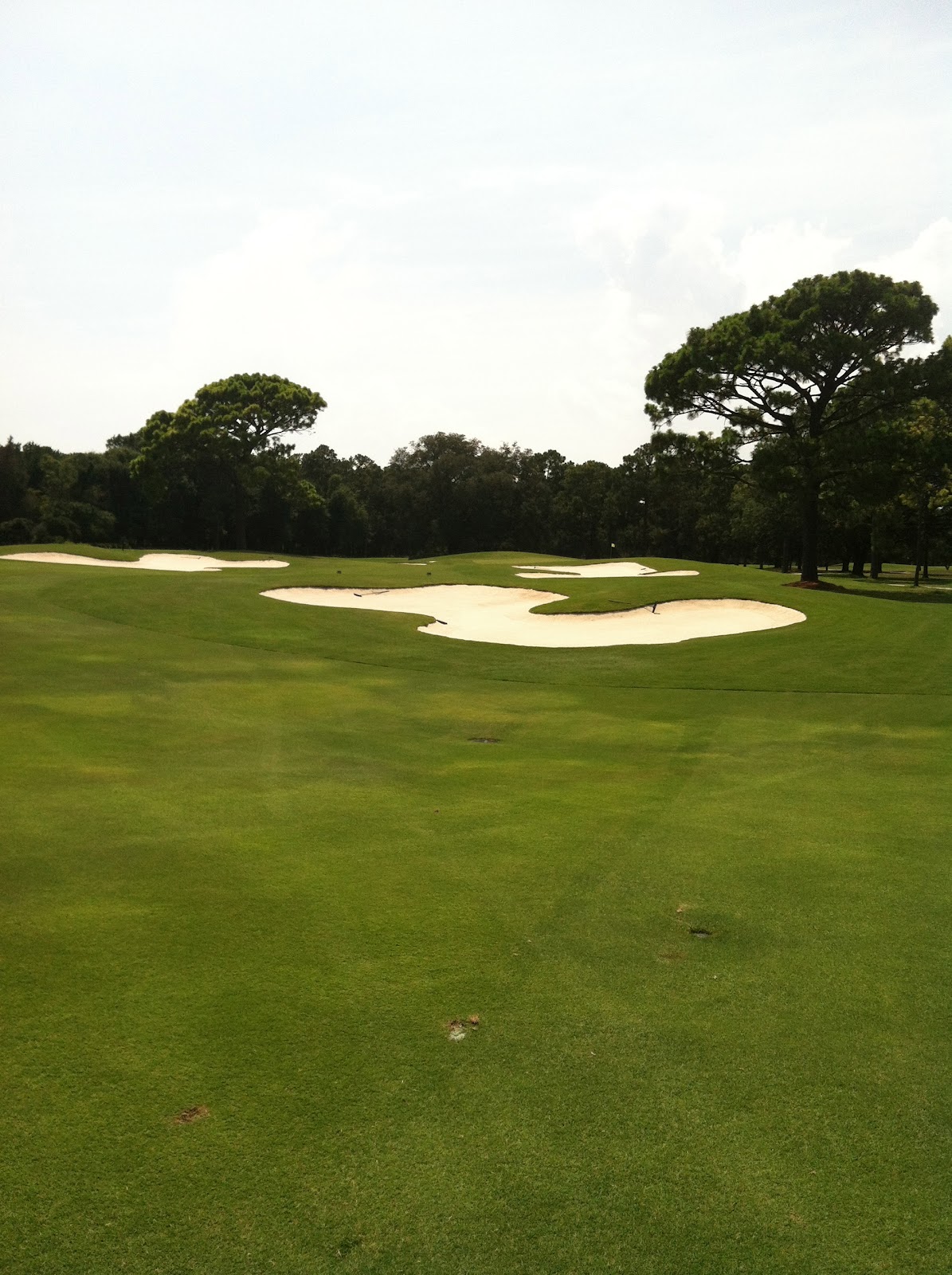
The bunker nearest the right side of the image is the key point from the tee.
From the angle close to the bunker, the player is given a clear play to the green, the pine on the right is no hazard.

Overall, this course is reasonable. It is not, however, worth the $120 they charge guests. Courses of the same quality can be found on the Trail, and virtually anywhere really, that are of the same quality but charge half as much. This is not a terrible course, but it is in no, way, shape, nor form worth the rate they charge. 4 out of 10.

Thursday

The "Next" Tiger Woods

The talk about who can be the next Tiger Woods has started up again this week. This week the LPGA Tour saw it's record for the youngest winner broken by 15 year old Lydia Ko from New Zealand. This is a major accomplishment for the youngster. On top of this, she is also a national champion in both New Zealand and the United States. But she is not the only one to rate such comparison.

Rory McIlroy won the PGA Championship a few weeks back. Immediately that prompted reports to compare him to Tiger and how they won majors. Rory is now one of eight active golfers on the PGA Tour with more than one major championship victory and by far the youngest.

So naturally these two golfers might be compared to Tiger Woods and his accomplishments at a young age. But does the world of golf really need another Tiger Woods?

To be sure, Tiger Woods has electrified the sports world for fifteen years now; longer than young Miss Ko has been alive in fact. He has set records and done things few thought possible from one side of the planet to the other. But, of course, there is that other side of Tiger Woods, the one the world found out about in the days and weeks after November 27, 2009 and it is that side that must be considered, along with the golf, that must be considered when we talk about the "next" Tiger Woods.

Tiger's golf records are among the elite of the elite. He will almost certainly break Sam Snead's now forty-seven year old record for most PGA Tour wins. It is also likely that he will break Jack Nicklaus's twenty-six year old major championship record, though not as likely as it was four years ago. He has also made more money than any athlete in history.

But what of the rest? What about the fact that he spun a giant web of lies, feeding the public this image of a wholesome family man when the reality was something vastly different. The reality of the situation is that Eldrick Woods is a habitually unfaithful megalomaniac who surrounds himself with a bunch of bootlicking, glad-handing, yes men. The fact that he is capable of playing high level golf is secondary to all of this.

No, the world of golf needs no more than one Tiger Woods. Certainly one must be enough. Perhaps we should ask who will be the next Tom Watson  or Phil Mickelson. Those two, while having some vices and not being quite the same caliber of golfer as Tiger, are certainly better overall people than is Tiger. Perhaps the time has come to stop glorifying Tiger Woods and look at him for what he really has become.

Even after his "transgressions" as he, well, I suppose the truth would be his speech writers, phrased it, he has made no real change. He still, seemingly, surrounds himself with various and numerous ladies. He is still a stand-offish tool with the media. He still employee's a flock of yes-men, bowing at his feet. Indeed, it would seem poor, and almost insulting, to compare young Miss Ko to Tiger Woods.

No, the media obsession with comparing people to Tiger Woods, comparisons that have been going on for ten years now, are poor and inappropriate nowadays. Tiger has long since violated any trust people may have had. Anyone breaking into golf today should hope that they are not the next Tiger Woods. Unless, of course, they want to forever be known as someone who lied to the public for years and, overnight, went from Tiger Woods: Great Golfer to Tiger Woods: Adulterer and Liar.

Wednesday

Palmer Golf Course- Palmer, AK


This course most certainly made the best out of what is a very difficult site. First, the site is as flat as a large piece of land can be, having only forty feet of elevation change from one end of the course to another, a distance of nearly a mile and a half; it seems like less change than that when playing the course. On top of that, the site is wedged between Palmer Airport and the Matanuska River. There is a mandated set-back off of the airport and the river could not be used for scenery as much as possible due to wind blowing sediment from the river bed onto the greens. But even with these difficulties, there sits a solid golf course that is certainly fun to play.

Holes to Note

Hole #2: Par 4, 395 yards
The player is given several choices off this tee. The safe play is to play the tee shot out to the left, away from the fairway bunker visible between the two trees in the center of the image. The other is to play over the bunker, a carry of about 250 yards. The play over the bunker will leave the better line into the green, as might be expected, but there might be a surprise waiting for the player beyond the bunker.
 From the tee, there would appear to be little that the player cannot see. The views of mountains in the distance are quite nice and offered on every hole, regardless of the direction of play.

 From the left side of the fairway, the player is left with a rather straight forward shot of 165 to 175 yards, if he chose to lay back far enough to take the bunker out of play. Visible here, however, is an additional bunker, farther from the tee and not seen from the tee. So, the 250 yard carry the player had to play over the first bunker becomes around 280. Many players have likely found that second bunker on their initial playing of the course.

But for those players long enough to carry the second bunker, a simple shot of around 100 yards awaits.

Hole #5: Par 3, 230 yards
The longest par 3 on the course plays to a green that is slightly elevated, but not elevated enough to prevent a shot from rolling onto the green. The green is quite nicely shaped, having a very irregular shape, something like a clover, and enough contouring to make it interesting, but not unplayable given the length.
 From the tee, any type of pull is obviously not wanted. This shot from the left side of the teeing area, however, makes the hole feel tighter than it really plays. The green provides a generous target and there are wide fringe areas that work to help slight misses. It is unknown if those flat and wide fringe areas used to be green areas and have been lost over the years.

Here you can see some of the shaping of the green. There is another finger of the green that extends out near the bunker on the right side of the image. This is a well shaped green and certainly able to provide challenge to the long incoming shots while still remaining playable. 

Hole #12: Par 4, 380 yards
This dogleg left hole provides a fair challenge to the player off the tee. With most dogleg holes, the play would seemingly be to play down the side of the dogleg in order to cut length off of the hole. However, here, playing down the left side will likely yield only trouble. Shots hugging the left side of the fairway will have to be hit at least 260 yards to avoid being blocked out by the trees on that side. However, any shot traveling over 285 yards runs the risk of winding up behind a large hardwood tree that is through the fairway. So, here, the left side is most certainly not the preferred side. The best play from this tee is a shot in the range of 240-260 yards played to the right-center of the fairway. This will allow for a relatively easy shot into the green.
 The green is not visible from the tee. It lies roughly directly below the point where the ridge line of the peak in the distance disappears behind the trees. Those trees hug tight to the fairway on the left, blocking out shots to the green.

This from the center of the fairway, roughly 120 yards from the green. This gives a fair look at the opening to the green, allowing for either aerial play or ground play. The green is also something of a punchbowl green, one of the few "classic" golf features to be found in Alaska.

Overall, this is a very solid golf course. It is very difficult to review this course in pictures because often times the scale of the photograph does no justice for the hole. On all the holes playing northwards (2, 3, 6, 8, 9, 10, 17) the scale is determined by the backdrop of the mountains that are ten miles distance and 3,500 to 4,000 feet in height. But this course is as good a course as this writer has seen given the nature of the site. 4 out of 10.

Tuesday

Doping in Sports

Doping in sports has come to the forefront recently with a few people being suspended from the Olympic games and, more significantly, Lance Armstrong likely being stripped of his Tour de France titles. This goes with numerous other athletes who have been in the headlines recently for alleged doping allegations. However, for the most part, none of these athletes have ever failed any drug tests. And on top of that, we, the general public, have enabled these athletes for years in their drug use.

Why was Lance Armstrong stripped of his Tour de France titles? In the end, what it really amounted to was that he refused to play the US Anti-Doping Administration's game anymore and participate in their witch hunt. In this day and age, it is apparently not necessary to actually fail a legitimate drug test to be guilty. The USADA simply refused to even consider that perhaps Armstrong was simply that much better than the rest of the competition. Consider that even now, at the age of 40, Armstrong is winning half-Ironman triathlons, defeating professionals over a decade younger than himself.

However, one reasonable thing about the USADA's decision (if it does come through as planned) is that they do show a willingness to strip people of titles and records, something Major League Baseball has thus far refused to do. Mark McGwire has admitted to using steroids during his 1998 baseball season and at other times. Barry Bonds tested positive for steroids in 2000, before his record setting year, as was released by Federal prosecutors. Numerous other baseball players have tested positive for drugs, yet their records and statistics still stand. Barry Bonds and Mark McGwire still have their records, however. But from all the press coverage on this, as well as other ball players, notably Roger Clemens, shows that all this is essentially a modern-day Salem Witch Hunt. And of course, government agencies and those supposed, self-appointed, guardians of the purity of sport at the USADA find it necessary to waste large sums of money to do so.

But the worst part of the whole situation is that we have enabled this situation. I recall vividly sitting in the living room at my parent's house with my dad watching Mark McGwire play Sammy Sosa and the Chicago Cubs attempting to break Roger Maris's home run record. And he did so. Citizens nationwide cheered, as did the thousands in attendance at the ballpark, at this ball player breaking Maris's sacred record. We then sat around, selling out park after park while Barry Bonds did the same thing just a few years later. We've watched and cheered our Olympic heros as they failed drug tests. People watched professional wrestling in record numbers during the 1980's as wrestlers pumped all grades of chemicals into their bodies. And we continue to watch all these sports even though athletes are suspended quite often for drug use. Truth is, we, the public are consumers of this entertainment. Do not attempt to fool yourself, professional "sports" are not sports at all. They are merely athletic entertainment pursuits that we pump vast amounts of money in to. At least the WWE is honest enough to call their product entertainment; baseball, football and others would still have us believe that this is sport.

Until people refuse to pay drug users and pay to see them, this will continue. Athletes will continue to abuse drugs and do everything possible to skirt the system. Teams will continue to write them record contracts. And citizens will continue to pay good money to watch these teams and athletes. I'd just prefer the witch hunt that has been going on for some ten years now will end and these athletes, drug users or not, will be allowed to live their lives in peace and, hopefully, obscurity.

Monday

Length Based Designators for Golf Courses

What is a long golf course? What is a very long golf course? For the purposes of some future discussions and course reviews that are likely to take place on this site, perhaps some definitions are in order.

The shipping industry has some uniform designators based on ship size. One standard set of designators, there are several "standards," rates ships as Crude Carriers (meaning ships that carry bulk shipments of unrefined crude oil/petroleum), Large Crude Carriers, Very Large Crude Carriers and Ultra Large Crude Carriers. The numbers used to make these determinations are virtually meaningless to the non-mariner and also not of real use here. But could a system like this work for golf courses?

Indeed, it could. Using the shipping model, there are very few ULCC's. As such, it makes sense that there would be very few Ultra Long Golf Courses. It seems reasonable that a ULGC is any course longer than 7,700 yards.

The Very Long Golf Courses (VLGC) designator could go down from there and cover courses between 7,300 and 7,700 yards.

The Long Golf Course (LGC) designator could be 6,900 to 7,300 yards.

And the standard Golf Course (GC) designator could be courses below 6,900 yards.

Of course, if desired, there could also be an additional, perhaps quite useful, designator of Short Golf Courses (SGC) for those courses below 6,100 yards.

Perhaps these designators can be used to sort through and categorize the various golf courses as they may be profiled.

Sunday

Ross Bridge and the case for Ultra Long Courses

Ross Bridge most certainly fits the mold of an ultra long golf course (ULGC). Topping out at nearly 8,200 yards, it is most certainly one of the longest courses in America, with this writer knowing of only the International (Pines) course in Massachusetts being longer. But one of the major negatives that courses like this face, along with another ULGC in California, Sevillano Links (7,823 on the card with ability to play longer), is the lack of variety in hole lengths.
A quick look at the cards for each course, Ross Bridge and Sevillano Links, both of which this writer has played, shows:
Listed in order Ross Bridge/Sevillano Links

Shortest Par 3: 207/191
Shortest Par 4: 454/386
Shortest Par 5: 571/553

Longest Par 3: 239/262
Longest Par 4: 518/509
Longest Par 5: 698/686 (Should be noted that the longest par 5 at Sevillano Links can play 709 yards)

Compare this to a course like Oakmont, which while coming in roughly 1,000 yards shorter than Ross Bridge, has greatly more variety:
Par 3: 183/288
Par 4: 313/500
Par 5 609/667 (only 2 par 5's on course)

What Ross Bridge and Sevillano Links miss in their quest for yardage is variety, though Sevillano Links has better variety than does Ross Bridge. But what should be studied is the likely reason for this lack of variety. Truth is, all those holes, while being part of ULGC's, all fall inside nice little boxes that most golfers find comfortable. In years past, a 518 yard or 509 yard par 4 would have seemed incredible, but now, we have seen a 525 yard par 4 in 2009 at the US Open and 523 at the 2011 US Open. Same with a 262 yard par 3, shorter than the listed par 3 at Oakmont.

The catch with the par 3 at Oakmont is that it does not fit within the comfort range for holes. It gets to the point that all but the longest of the long hitters must play a driver into the green and that is unsettling for many golfers.

No, as it stands right now, virtually all golfers are comfortable with seeing par 4's up to and beyond 515 to 525 yards; The International (Pines) has a par 4 that plays out to 567 yards, though it is unknown to this writer if that hole plays downhill or not. The truth is, however, that it takes a hole that long in order to prompt the high level golfer to hit a fairway wood into the green. But, same at the 288 yard par 3, a 567 yard par 4 does not fit inside the comfort zone of many golfers.

Par 5's go the same way. This year's US Open championship had a par 5 that was 670 yards from the back markers. However, the fairway had to be mown into such a narrow corridor as to be almost comical. Without such trickery, a 670 yard hole, for elite players on fairways as firm as those, will be nearly reachable in two shots and would rarely be approached with a club less than a short wedge (if we are to figure a 300 yard drive, followed by a 270 yard second shot, the player would be left with 100 yards to the green, hardly a difficult shot in most conditions). The par 5 13th hole at Ross Bridge is 698 yards from the back markers, yet this writer played it, from those markers, using Driver, 3 wood, Gap Wedge, again, hardly difficult. In order for a par 5 to play as a real three shot hole, requiring a 5 iron or higher approach, without some form of trickery, the hole would need to be greater than 770 yards in length, if we are to assume the same first and second shots listed above, followed by a 200 yard 5 iron. Again, though, that length would fall outside of a normal comfort zone for golfers.

However, what could be done, if we break out of those comfort zones, and create an ULGC that is also exceptionally varied? Have par 3's that can be approached with wedges, coupled with one that needs to be approached with a 3 wood. Par 4's reachable from the tee and also out to such a length that also requires a 3 wood approach. And of course par 5's that are reachable, or nearly so, on the second shot, but also one requiring 3 full shots, perhaps even a long iron or fairway wood approach.

Another comfort zone for golfers is the standard course make up of 4 par 3's, 10 par 4's and 4 par 4's. This, of course, limits what the designer can do because he is bound to a certain course make-up. As such, between this standard make-up and individual hole comfort zones, it becomes very difficult for the designer to design an ULGC without significant repetition. But what about breaking that up?

On a given site, were an architect to wish to design an ULGC, this of course assuming he had enough land and a site suited to such, it would be rather easy to create such a course, even using the standard make-up, if you break the conventional hole models.

A solid and varied set of par 3's might have yardages like: 140/190/225/285
Par 5's could go: 585/680/710/825
And Par 4's: 310/355/395/420/465/480/490/515/530/565
That comes to a yardage of 8,165 yards. Other markers could be laid out in front of that in order to get playability for any groups necessary.

But what could be done if we break the mold slightly and go with only 3 par 3's and par 5's?
Par 3's: 140/210/285
Par 5's: 585/680/825
Par 4's: 310/355/395/420/450/465/480/490/500/520/530/565
And this for a yardage of 8205.

Yet both of these courses had incredible variety in the holes. All because of being able to step outside normal comfort zones and designing holes that really do test elite golfers in their ability to hit fairway clubs into holes, while also testing their ability to hit short wedges.

It seems strange to look at elite golf courses and see the variety that exists in them and not attempt to recreate some of that when attempting to design an ULGC. The truth is, both of these, exceptional variety and exceptional length, can coexist and in all likelihood form a magnificent golf course. Someone should attempt this, rather than semi-boring repetition that exists on most ULGC's.

(As a side note, this writer greatly enjoyed his rounds at both Ross Bridge and Sevillano Links, he just thinks courses like this could be better if they had greater variety in the hole lengths)

Robert Trent Jones Golf Trail at Oxmoor Valley (Short)


This is not a terrible course for those looking to get in a little bit of practice late in the day or as an add-on round after a turn around one of the main courses. The biggest drawback to the course, and it is a huge one, is that the course is an extremely difficult walk. But overall, this is a fair course.

Holes to Note

Hole 2, 224 yards
Very long hole, the second longest on the course in fact. Played downhill to a generous green built with large fall off areas short, right and long. Certainly a difficult second hole.


Hole 5, 135 yards
Nice short hole coming on the heels of three real beasts. But this hole is no sleeper being played into an undulated green with a large fall off long of the green.

Hole 14, 253 yards
This longest par 3 on the course is also the poorest routed hole on the course. The tee is slightly above the level of the green, but there is a 110 feet deep depression between the tee and green that the player must walk down and back up in order to reach the green. This is an exceptionally poorly routed hole, though the fun in playing a very long par 3 like this can make up for that slightly.
This image not taken from the back markers

This is a fair course overall. Not as much variety as could be done with a par 3 course, but it's nothing terrible either. Could have been routed much better though. 3 of 10

Scenic Hills Country Club-Pensacola, FL


This is a solid course, but could be better without the housing around it. Course hosted the US Women's Open in 1969 and the course makes certain anyone who plays here knows that. As far as being walkable, Scenic Hills is as easily walked as a course routed through housing like this can be. Most of the holes are high on options, allowing for ground play at times and requiring the high lofted shots at others. The only negative is that, while walkable, the course requires that non-members take carts. While this course isn't anything really special, it is a solid public course and a good value.

Holes to Note
Hole #1: Par 4, 443 yards
This is a very solid opening hole. Playing substantially downhill off the tee brings the effective yardage down much lower than the card yardage. The fairway is also quite wide, giving the player a generous target even though the hole plays between houses on both sides of the fairway. The preferred angle of approach into the green will come from the left side of the fairway, allowing the player to avoid the bunkers that protect the right side of the green.

From the left side of the fairway, the green, while being a small target, is accessible with a straight forward shot, and the player could even attempt to roll the ball onto the green.


However, from the right side of the fairway, the angle of the green is not quite so inviting and a slight push for players going for the center of the green will likely find one of the two flanking bunkers.


The green is nicely perched up, falling away into the bunkers on the right, a depression on the left and a bunker awaits beyond the green for those players suffering from a lack of distance control.


Hole #13: Par 4, 357 yards
This is a fancy little mid-to-short par 4. The tee shot has to carry a water hazard, a hazard that was likely unavoidable in the design of the course as it is part of the Escambia River watershed area, but the hazard is not that difficult to cross, a mere 100 yards from a back markers. The hole itself bends to the left and the fairway will kick shots down towards the left side of the fairway. However, the player looking for the easiest approach into the green had better play his shot up the rigth side so as to not be forced to carry the two bunkers lying in wait off the left side of the green.


From the right side of the fairway, the player is left with a simple, straight shot into the green, most likely with a wedge in hand.


Hole #17: Par 5, 507 yards
This very scenic par 5 provides the player a great chance to make a birdie coming home in the round. The hole plays virtually straight, although an arguement could be made that it is a double dogleg hole, going slightly right from the tee and then back left into the green. The green can be reached in two shots by the longer players. However, the player wanting to go for the green in two shots must play close to the dual purpose bunkers down the right side of the fairway. These bunkers are effective in two ways: first, they force strategic from golfers who are attempting to go to the green in two, and second, they act as saving bunkers for the less skilled golfers, possibly keeping the tee shot from going down into the hazard.

From the left side of the fairway, the player gets a solid view of the significantly elevated green. Any player attempting to reach the green in two shots is going to have to navigate a field of bunkers, both surrounding the green and flanking the fairway about 50 yards short of the green. The best play into the green, for those normal players not hitting a 6 or 7 iron, is a draw that lands short of the green and rolls up. That shot however will have to thread between the greenside bunkers.


For the player choosing to lay up, once again the right side of the fairway provides the best line into the angled green. Obviously any shot that comes up short of the putting surface or is struck with too much spin is liable to roll back off the green a significant distance.


Overall, this is a solid little golf course. With exception of the houses running down the holes, there are only a few negatives. The course does have one feature that always irritates this writer to no end and that is the forced water carry with no strategic value. The 11th hole has a forced carry of a creek that is in the range of 400 yards off the tee, giving no strategy to the tee shot, and also some 150 yards short of the green, offering nothing to the green either. No, the creek merely sits there offering no thought or strategic interest to the player with enough skill to easily carry it on the second shot (and it must be the second shot because, lets face it, there are perhaps half a dozen people in the world who could reach it off the tee) and yet offers nothing but a huge penalty to those golfers who struggle to get the ball into the air and make the carry. Those golfers must either attempt to make a tough shot and possibly dunking a ball into the water or lay up short of the hazard leaving a shot into the green that they likely can not make. No, forced carries are fine, but not like this.

Other than that, the course is solid. It has solid variety in all the holes and an understated character that is sadly missing from many new courses. 4 out of 10.

Friday

"Most Fun" Golf Course Ranking

In this month's edition, Golf Digest published three lists of the Most Fun Golf courses, one for public in America, one for private and one for Great Britain and Ireland. These lists will not be reproduced here due to the fact that they have not yet been posted on the Golf Digest website. However, I feel a little discussion is in order about some of the rankings. The private and GB&I lists are both discarded from this discussion as I have played none of the 70 courses listed. However, I have played 7 of the top 50 public courses.

First, as Bandon Dunes noted on their site, the Resort has 3 of the top 5 and 4 of the top 6, with Old Macdonald being ranked #2, Bandon Preserve #3, Pacific Dunes #4, and Bandon Dunes #6. Bandon Trails makes the list at #27. My first thought when I read this was "I wonder how much the resort had to pay to get THOSE rankings?" I stand by that assessment. How was this list determined? I have played 3 of the 5 courses at Bandon, and while they were certainly fun to play, I can't honestly say that I had exponentially more fun at Bandon playing with a great group of guys than I had about a month later playing Metropolitan Municipal in Oakland, CA with virtually that same group of folks.

No, it seems to me that the magazine simply threw together a list of courses that are popular today and/or have some kind of scenery involved. It seemingly does not take anything else into consideration. What is their justification for the Gil Hanse designed Rustic Canyon being ranked #30, so far behind the Bandon courses? Did Gil or the club forget to cut a check to Golf Digest? What of a course like Tobacco Road, a course with more variety and visual stimulation than most on the list than I have seen?

There is little rhyme or reason here and no mention of what methodology was used to determine this list. The #1 course on the list, Pebble Beach, is certainly understandable given the course's history and aura. But beyond that, it gets a little lost, honestly leading me to believe that this list was merely bought and paid for by advertisers and glad handing course owners trying to get their names at the top of the page. Take my not so humble opinion for whatever you choose to, but do so with the knowledge that I simple tell things as I see them. Sometimes, that might irritate people...and I do not care.

Thursday

Augusta National and Female members

It was announced on Monday, August 20 that the Augusta National Golf Club has admitted two females into its membership. The club's reason for accepting two ladies into the membership right now is unknown to this writer and really does not matter. Truthfully, even the fact that they now have women as members does not matter. No, in reality, this will do virtually nothing to change anything about the world of golf, any "rights" discussion among non-White, Anglo-Saxon, Protestant, Heterosexual, Male groups, and won't affect any part of my life, either.
This little happening will not do anything to change the world of golf. Sure, now the club can be acting in accordance with PGA Tour rules about not having restrictive membership practices, but that knowledge likely did not factor into the clubs decision at all. I should say that the club cares no more today than they did yesterday, or any of the previous 29,107 +/- days of its existence, that they have female members. Nothing about the culture of the club is going to change. And nothing about the world of golf as a whole is going to change. The game will still be difficult to access for a huge segment of the population due to economic status or lack of available courses. Not to mention the outright discrimination that takes place at many clubs, which leads to my second point.
Augusta National never out rightly said that women could not be members. They simply did not have one. This in contrast to places like Shoal Creek where it was blatantly stated that they would not allow African-Americans to be members. Or some of the older clubs where there are written policies in place stating they are open to males only. Or clubs that don't allow Jewish people to be members. The list could go on, of course. Now, it is no one’s place to tell these clubs who they should or should not allow as members. They are private clubs with the ability to do as they choose. However, it should be obvious to most that individuals who do not fit into the White, Anglo-Saxon, Protestant, Heterosexual, Male mold often times have difficulty joining all manner of private clubs. From high profile golf clubs to middle of the road country clubs to athletic clubs even down to organizations like small town hunt clubs, restrictive practices exist everywhere. Augusta National Golf Club accepting two women, no matter how high profile they may be (though, in reality, how large a percentage of the population, outside the states of South Carolina and Texas, had heard of Darla Moore prior to Monday?) will not alter the reality of the situation nor will it prompt any clubs to change practices.
But finally, does this decision by Augusta National affect *my* life or *your* life? I should think that unless you are close personal friends with former Secretary of State Rice or Ms. Moore, it does not really alter your life at all. Your chances of playing Augusta National prior to death were likely close to the chance that you will see a unicorn on the way to work today. Those chances have not improved.
No, the truth is, nothing has changed. The Master's will still go on next year, same as it did this year. As much as some might want to think this is some great step forward for golf and non-White, Anglo-Saxon, Protestant, Heterosexual, Male "rights," it is not. This decision does not affect you, it does not affect me, and it does not break down any glass ceilings. While it is not a bad thing that Augusta National accepted women into the membership, it is no earth-shattering happening. It is really something of a neutral item that is getting blown up on a slow news day. Do not expect to see any huge shift in club cultures or anything else because of this.